Related Rates
We developed the general strategy we will use to solve related rates problems in our blog post 4 Steps to Solve Any Related Rates Problem - Part 1. (Link will open in a new tab.) You might find it helpful to read that post if you haven't already since we start with "How to Recognize a Related Rates Problem" and then develop the rest from there.
On this screen we have many practice problems for you to use, each with a complete solution immediately available. Practice here and get stuck in all the places students usually do so you can work through the challenges and be ready for your exam!
Related Rates Problem Solving Strategy
For convenience, let's repeat our problem solving strategy here since we'll use it solve every problem on this page:
PROBLEM SOLVING STRATEGY: 4 Steps to Solve Related Rates Problems
We developed the general strategy we will use to solve these problems in our blog post 4 Steps to Solve Any Related Rates Problem. (Link will open in a new tab.) You might find it helpful to read that post before proceeding if you haven't already.
The following steps are not a recipe for you simply to follow, but rather a sequence to help guide your thinking and lead you to be able to solve each problem you encounter.
- Draw a picture of the physical situation.
- Write an equation that relates the quantities of interest.
Be sure to label as a variable any value that changes as the situation progresses; don't substitute a number for it yet. To develop your equation, you will probably use:
- a simple geometric fact (like the relation between a sphere's volume and its radius, or the relation between the volume of a cylinder and its height); or
- a trigonometric function (like
t a n 𝜃 - similar triangles; or
- the Pythagorean theorem.
- Take the derivative with respect to time of both sides of your equation. Remember the chain rule.
- Solve for the quantity you're after.
In the subsections below, we'll solve each problem step-by-step using the strategy outlined in the Problem Solving Strategy box below. Each subsection lets you practice a specific approach that's listed in Step 2.B of the Problem Solving Strategy:
- Geometric fact. Typical problems: A circle's radius changes, a snowball melts, a rectangle's height and/or width changes.
- Trig function. Typical problems: A searchlight rotates, a rocket takes off, a kite travels horizontally.
- Similar triangles. Water fills a cone or trough, sand falls onto a conical pile, person walks away from a light pole that casts a shadow.
- Pythagorean theorem. Typical problems: Cars/ships/joggers move along 90 degree paths, baseball players run along the diamond, boat is pulled toward a dock.
Be sure to practice some of each — but if you need to focus your time, put it on similar triangles and the Pythagorean theorem since those problems appear most frequently.
Before we dive into typical related rates questions, let's actually examine one that sometimes shows up in beginning homework problems where an equation is simply given to you and so you essentially skip the first two steps of our process and jump right to Step 3.
Related Rates: Given an Equation, Find the Rate
If
View/Hide Solution
We can still use our Related Rates Problem Solving Strategy above. Instead of starting at Step 1, we simply start at Step 3:
3. Take the derivative with respect to time of both sides of your equation. Remember the chain rule.
4. Solve for the quantity you're after.
We want to find
Related Rates: Using a Simple Geometric Fact
Many related rates problems make use of a simple geometric fact. For example,
- the area of a circle is
𝐴 = 𝜋 𝑟 2 - the volume of a sphere is
𝑉 = 4 3 𝜋 𝑟 3 - the area of a rectangle is
𝐴 = 𝑙 𝑤
and so forth.
The following problems illustrate.
As a snowball melts, its area decreases at a given rate. How fast does its radius change? (Video solution)
A spherical snowball melts symmetrically such that it is always a sphere. Its surface area decreases at the rate of
View/Hide Solution
[Scroll down for text-based (non-video) version of the solution.]
Let's unpack the question statement:
- We're told that the snowball's area A is changing at the rate of
𝑑 𝐴 𝑑 𝑡 = − 𝜋 2 - As a result, its radius is changing, at the rate
𝑑 𝑟 𝑑 𝑡 - The snowball always remains a sphere.
- Toward the end of our solution, we'll need to remember that the problem is asking us about
𝑑 𝑟 𝑑 𝑡 𝑟 = 2
We of course use our 4 steps to solve this related rates problem as outlined in the Problem Solving Strategy box above:
1. Draw a picture of the physical situation.
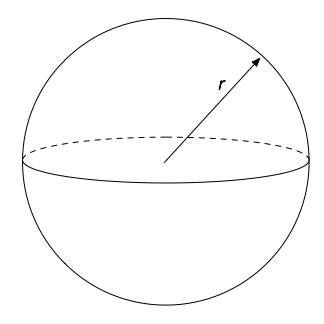
See the figure.
2. Write an equation that relates the quantities of interest.
B. To develop your equation, you will probably use. . . a simple geometric fact.
This is the hardest part of Related Rates problem for most students initially: you have to know how to develop the equation you need, how to pull that "out of thin air." By working through these problems you'll develop this skill. The key is to recognize which of the few sub-types of problem it is as described in the Problem Solving Strategy box above. In this problem, the diagram above reminds us that the snowball always remains a sphere, which is a Big Clue.
We need to develop a relationship between the rate we're given,
3. Take the derivative with respect to time of both sides of your equation. Remember the chain rule.
4. Solve for the quantity you're after.
Solving the equation above for
Now we just have to substitute values. Recall
and the problem asks about when
That's the answer. The negative value indicates that the radius is decreasing as the snowball melts, as we expect.

Caution: IF you are using a web-based homework system and the question asks,
At what rate does the radius decrease?
then the system may have already accounted for the negative sign and so to be correct you must enter a POSITIVE VALUE:
We can't guarantee how this problem was coded into your homework system, and so unfortunately can only advise that if you think your answer of a negative value is correct but the system is marking it as wrong, try entering it as a positive value. (Many students have thanked us for this suggestion!)
Snowball melts at constant rate of volume change, radius decreases
Let's unpack the question statement:
- We're told that the snowball's volume V is changing at the rate of
𝑑 𝑉 𝑑 𝑡 = − 2 𝜋 3 - As a result, its radius is changing, at the rate
𝑑 𝑟 𝑑 𝑡 - The snowball always remains a sphere.
- Toward the end of our solution, we'll need to remember that the problem is asking us about
𝑑 𝑟 𝑑 𝑡 𝑟 = 1 0
1. Draw a picture of the physical situation.
 See the figure.
 2. Write an equation that relates the quantities of interest.
B. To develop your equation, you will probably use. . . a simple geometric fact.
In this problem we're given the value for
Solving the equation above for
 Caution: IF you are using a web-based homework system and the question asks,
At what rate does the radius decrease?
then the system (probably) has already accounted for the negative sign and so to be correct you must enter a POSITIVE VALUE:(Why "probably"? Because the truth is it depends on how the question got coded into the system, and problem-writers often aren't consistent here. It's annoying.)
Circle expands
When a circle expands, obviously its area changes; the rate at which its area changes is
 1. Draw a picture of the physical situation.
See the figure.
2. Write an equation that relates the quantities of interest.
B. To develop your equation, you will probably use . . . a simple geometric fact.
Because we ultimately need a relation between
The problem is asking us to find r at the instant when
Starting from the preceding equation:
Rectangle, area increases as sides change
Let's first unpack this question:
We're given that the rectangle's length is changing at the rate
 1. Draw a picture of the physical situation.
See the figure.
2. Write an equation that relates the quantities of interest.
A. Be sure to label as a variable any value that changes as the situation progresses; don't substitute a number for it yet.
The rectangle's width and the length are both changing, so we'll leave them each as a variable.
B. To develop your equation, you will probably use . . .a simple geometric fact.
We're looking for
Both
We want
Hence
Rectangle maintains constant area as its length increases
This rectangle has constant area; you might imagine it as a flat piece of rubber that has constant area. As you stretch it out in one direction, it must shrink in the other to compensate. The faster you stretch it out, the faster its width must decrease to keep the area constant.
The problem tells us that the length is changing at the constant rate
1. Draw a picture of the physical situation.
See the figure.
2. Write an equation that relates the quantities of interest.
A. Be sure to label as a variable any value that changes as the situation progresses; don't substitute a number for it yet.
The rectangle's width and the length are both changing, so we'll leave them each as a variable.
B. To develop your equation, you will probably use . . .a simple geometric fact.
Here we use the relation between the area of a rectangle and its width and length. Remember that the problem says that the rectangle's area stays constant at 500 cm
Both
We want to find
Looking at the preceding equation, we see that we currently have two unknowns,
Then from the preceding equation:
Square's sides grow, increasing both its perimeter and area
A square has side-length x. Each side increases at the rate of 0.5 meters each second.

Cube's sides grow, increasing both its volume and surface area
A cube has side-length x. Each side increases at the rate of

Cylinder drains: depth decreases at constant rate. Find the rate of water draining.
 1. Draw a picture of the physical situation.
See the figure. Let's call the height (or depth) of the water at any given moment y, as shown.
We are told that the water level in the cup is decreasing at the rate of
2. Write an equation that relates the quantities of interest.
A. Be sure to label as a variable any value that changes as the situation progresses; don't substitute a number for it yet.
The height of the water changes as time passes, so we're calling that the variable y.
B. To develop your equation, you will probably use . . . a simple geometric fact.
The volume V of any cylinder is its circular cross-sectional area
3. Take the derivative with respect to time of both sides of your equation. Remember the chain rule.
Note that the cylinder's radius, r, is constant (r = 3.0 ft), so we'll treat it as a constant when we take the derivative. By contrast, the water's height y is not constant; instead it changes, and indeed, it changes at the rate
4. Solve for the quantity you're after.
At this point we're just substituting values: the problem told us
Caution: IF you are using a web-based homework system and the question asks,
At what rate does the volume decrease?
then the system has already accounted for the negative sign and so to be correct you must enter a POSITIVE VALUE:Related Rates: Using a Trig Function
If a problem asks you how fast an angle is changing, you must use a trigonometric relationship to related the angle to other changing quantities. That is, you'll use one of these:
The following problems illustrate.
Ladder slides, angle changes
 1. Draw a picture of the physical situation.
See the figure. We've labeled the ladder's position along the ground x, and its position along the wall y. These both change as the situation unfolds, so we've left them as variables. (The ladder's length of 10 feet, by contrast, is a constant.) We've also labeled the angle
2. Write an equation that relates the quantities of interest.
B. To develop your equation, you will probably use . . . a trigonometric function (like
We need to use a trigonometric function to analyze this situation, since we need to relate the angle
3. Take the derivative with respect to time of both sides of your equation. Remember the chain rule.
4. Solve for the quantity you're after.
We're after
Begin subproblem to find
We know
Hence
Kite flies horizontally; find the rate of change of the angle between the string and the ground
 1. Draw a picture of the physical situation.
See the figure. We've called the length of string to the kite
2. Write an equation that relates the quantities of interest.
A. Be sure to label as a variable any value that changes as the situation progresses; don't substitute a number for it yet.
The string's length changes as the situation progresses, so we're calling that the variable
B. To develop your equation, you will probably use . . . a trigonometric function (like
In this problem, the diagram above immediately suggests that we're dealing with a right triangle. Furthermore, we need to related the rate at which
Specifically, we notice that x is the side of the triangle that is adjacent to the angle. Furthermore, the opposite leg of the triangle remains constant throughout the problem, since the kite's height is always 30 m. Hence at every moment:
3. Take the derivative with respect to time of both sides of your equation. Remember the chain rule.
4. Solve for the quantity you're after.
Let's solve the preceding equation for
Caution: IF you are using a web-based homework system and the question asks,
At what rate does the angle decrease?
then the system has already accounted for the negative sign and so to be correct you must enter a POSITIVE VALUE:Rocket flies straight up; find the rate of change of the angle between the line of sight and the ground
By how many radians per second is

1. Draw a picture of the physical situation.
See the figure.
2. Write an equation that relates the quantities of interest.
A. Be sure to label as a variable any value that changes as the situation progresses; don't substitute a number for it yet.
In this case, the height changes as the rocket travels, so keep calling it
The picture immediately suggests a relation between the angle
Remember that
In order to use the preceding equation, we need to know
When
We can now solve for
Related Rates: Using Similar Triangles
A lot of problems you encounter require that, when you look at your figure, you see a smaller triangle embedded in a larger triangle. Because the smaller triangle and the larger triangle have identical angles, they are similar triangles, and hence the ratios of the corresponding sides are equal.
Note again the importance of starting with a clear figure, so that you can see the triangles!
The following problems illustrate.
Man's shadow moves along the ground as he walks away from light post (Video solution)
A 1.8-meter tall man walks away from a 6.0-meter lamp post at the rate of 1.5 m/s. The light at the top of the post casts a shadow in front of the man. How fast is the "head" of his shadow moving along the ground?
View/Hide Solution
Answer: 2.1 m/s
[Scroll down for text (non-video) version of the solution.]
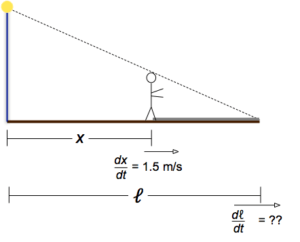
1. Draw a picture of the physical situation.
See the figure. We're calling the distance between the post and the "head" of the man's shadow
2. Write an equation that relates the quantities of interest.
We are given that the man is walking away from the post at the rate
There's a subtlety to this problem that typically goes unaddressed: We're focusing on
B. To develop your equation, you will probably use . . . similar triangles.
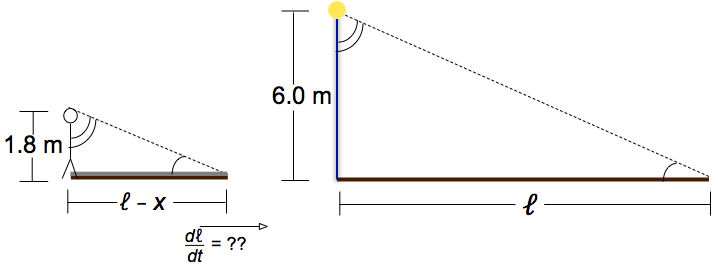
In the figure above we've separated out the two triangles. Notice that the angles are identical in the two triangles, and hence they are similar. The ratio of their respective components are thus equal as well. Hence the ratio of their bases
3. Take the derivative with respect to time of both sides of your equation.
4. Solve for the quantity you're after.
We're looking for
Regarding the preceding problem, students often ask what changes if the person walks toward instead of away from the light pole. The simple answer is that
Man's shadow moves along the ground as he walks toward light pole

1. Draw a picture of the physical situation.
See the figure. We're calling the distance between the pole and the "head" of the man's shadow
2. Write an equation that relates the quantities of interest.
We are given that the man is walking toward the pole at the rate
There's a subtlety to this problem that typically goes unaddressed: We're focusing on
B. To develop your equation, you will probably use . . . similar triangles.

In the figure above we've separated out the two triangles. Notice that the angles are identical in the two triangles, and hence they are similar. The ratio of their respective components are thus equal as well. Hence the ratio of their bases
We're looking for
Man's shadow on the wall changes length as he walks
 1. Draw a picture of the physical situation.
See the figure. We've labeled the distance from the spotlight to the man x. The man is thus moving at the rate
2. Write an equation that relates the quantities of interest.
A. Be sure to label as a variable any value that changes as the situation progresses; don't substitute a number for it yet.
The man's position changes as he walks, so we're calling his distance from the spotlight x.
B. To develop your equation, you will probably use . . . similar triangles.
The problem gives us the rate
 Here we've separated out the two triangles. Notice that their angles are identical, and hence the triangles are similar. The ratio of their respective components are thus equal: the ratio of their heights
 3. Take the derivative with respect to time of both sides of your equation. Remember the chain rule.
We're given that
Caution: IF you are using a web-based homework system and the question asks,
At what rate does the shadow's height decrease?
then the system has already accounted for the negative sign and so to be correct you must enter a POSITIVE VALUE:Water drains from a cone at constant rate; water's level falls at what rate?
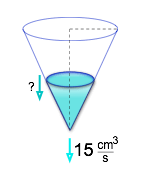
An inverted cone is 20 cm tall, has an opening radius of 8 cm, and was initially full of water. The water drains from the cone at the constant rate of 15 cm
(Note: The volume of a cone is
View/Hide Solution
Let's unpack the question statement:
- We're told that volume of water in the cone V is changing at the rate of
𝑑 𝑉 𝑑 𝑡 = − 1 5 3 - As a result, the water's height in the cone h is changing at the rate
𝑑 ℎ 𝑑 𝑡 - The inverted cone has a radius of 8 cm at its top, and a full height of 20 cm.
- The problem is asking us about
𝑑 ℎ 𝑑 𝑡 ℎ = 1 0
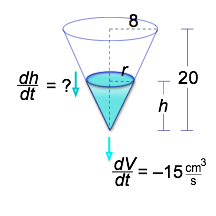
1. Draw a picture of the physical situation.
See the figure.
2. Write an equation that relates the quantities of interest.
A. Be sure to label as a variable any value that changes as the situation progresses; don't substitute a number for it yet.
The height of the water changes as time passes, so we're going to keep that height as a variable, h.
B. To develop your equation, you will probably use . . . similar triangles.
This is the hardest part of Related Rates problem for most students initially: you have to know how to develop the equation you need, how to pull that "out of thin air." By working through these problems you'll develop this skill. The key is to recognize which of the few sub-types of problem it is, as listed in our Problem Solving Strategy box at the top of the page.
Here we need to develop a relationship between the rate we're given,
Notice that this relation expresses the water's volume as the function of two variables, r and h. We can only take the derivative with respect to one variable, so we need to eliminate one of those two. Since the question asks us to find the rate at which the water is falling when its at a particular height, let's keep h and eliminate r as a variable using similar triangles.
Begin subproblem to eliminate r as a variable.
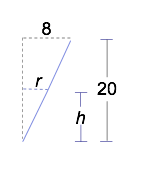
The figure is the same as in Step 1, but with the rest of the cone removed for clarity. Note that there are two triangles, a small one inside a larger one. Because these are similar triangles, the ratio of the base of the small triangle to that of the big triangle
Hence
End subproblem.
Now let's substitute the expression we just found for r into our relation for V:
That's it. That's the key relation we need to be able to proceed with the rest of the solution.
3. Take the derivative with respect to time of both sides of your equation. Remember the chain rule.
4. Solve for the quantity you're after.
We have
Starting from our preceding expression, let's first solve for
That's the answer. The negative value indicates that the water's height h is decreasing, as we expect.
Caution: IF you are using a web-based homework system and the question asks,
At what rate does the water's height decrease?
then the system has possibly already accounted for the negative sign and so to be correct you must enter a POSITIVE VALUE:
This has everything to do with how the coder entered this problem into your homework system and nothing to do with the math or your understanding!
The following problem is essentially the same as the preceding one, except that water flows into instead of out of the cone. We include it here so you can see how the sign of
Water fills a cone at constant rate; water's level rises at what rate?
 1. Draw a picture of the physical situation.
See the top figure.
2. Write an equation that relates the quantities of interest.
We are given that the volume of water in the cup is increasing at the rate
A. Be sure to label as a variable any value that changes as the situation progresses; don't substitute a number for it yet. The height of the water changes as time passes, as does the water's surface area, so we're going to keep both of those as a variables, h and r.
We have a relation between the volume of water in the cup at any moment and those variables:
We don't want the radius
We have
Related Rates: Using the Pythagorean Theorem
And probably more than any other approach, you will find yourself invoking the Pythagorean theorem often. The typical clue to use this approach will be that you've drawn a right triangle, and are asked something about a distance that happens to equal the hypotenuse.
Note again the importance of starting with a clear figure, so that you can see the right triangle!
The following problems illustrate.
Ladder slides down a wall; how fast does the top move down (video solution)
A 10-ft ladder is leaning against a house on flat ground. The house is to the left of the ladder. The base of the ladder starts to slide away from the house. When the base has slid to 8 ft from the house, it is moving horizontally at the rate of 2 ft/sec. How fast is the ladder's top sliding down the wall when the base is 8 ft from the house?
View/Hide Solution
We have a video for this solution; a full written-out solution is below.
1. Draw a picture of the physical situation.
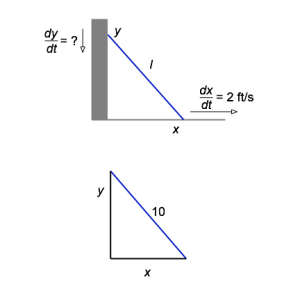
Let x be the horizontal distance, in feet, from the wall to the bottom of the ladder.
Let y be the distance, in feet, from the ground to the top of the ladder.
The problem tells us that at the moment of interest, when x = 8 ft,
2. Write an equation that relates the quantities of interest.
A. Be sure to label as a variable any value that changes as the situation progresses; don't substitute a number for it yet.
In this situation, both x and y change as the ladder slides, so we will leave both quantities as variables.
B. To develop your equation, you will probably use . . . the Pythagorean theorem.
This is the hardest part of Related Rates problem for most students initially: you have to know how to develop the equation you need, how to pull that "out of thin air." By working through these problems you'll develop this skill. The key is to recognize which of the few sub-types of problem it isas described in the Problem Solving Strategy box at the top of this page. In this problem, the diagram above immediately suggests that we're dealing with a right triangle. Furthermore, we need to related the rate at which y is changing,
While x and y change as the ladder slides, the hypotenuse of the right triangle shown is always equal to the ladder's length, 10 ft. Hence the Pythagorean theorem applies:
That's it. That's the key relation we need to be able to proceed with the rest of the solution.
3. Take the derivative with respect to time of both sides of your equation. Remember the chain rule.
4. Solve for the quantity you're after.
The question is asking us to find
To complete the calculation, we need to know the value of y at the instant when x = 8.
Begin subproblem to find the value of y at the instant when x = 8 ft.
We can find this value by using the Pythagorean theorem:
End subproblem.
Substituting all of the known values into the equation marked [*] above, we have:
That's the answer. The negative value indicates that the top of the ladder is sliding down the wall, in the negative-y direction.
Caution: IF you are using a web-based homework system and the question asks,
At what rate does the ladder slide down the wall?
then the system may have already accounted for the negative sign and so to be correct you may need to enter a POSITIVE VALUE:
This is annoying we agree, and has everything to do with whoever entered the problem into the system. Making matters worse, since different problems were probably entered by different people, within a given problem set you may find inconsistencies here; the best we can do is help you be aware.
Rectange maintains constant area as its sides change; find the rate its diagonal changes
 1. Draw a picture of the physical situation.
See the figure.
2. Write an equation that relates the quantities of interest.
A. Be sure to label as a variable any value that changes as the situation progresses; don't substitute a number for it yet. Both the width and the length of the rectangle are changing, so let's leave them both as variables.
B. To develop your equation, you will probably use . . .the Pythagorean theorem. We need to relate the rectangle's diagonal to its width and length:
Both
We want to find
First, we can find
Kite flies horizontally; find the rate at which the length of the string is changing
 1. Draw a picture of the physical situation.
See the figure. We've called the length of string to the kite
2. Write an equation that relates the quantities of interest.
A. Be sure to label as a variable any value that changes as the situation progresses; don't substitute a number for it yet.
The string's length changes as the situation progresses, so we're calling that the variable
B. To develop your equation, you will probably use . . . the Pythagorean theorem.
In this problem, the diagram above immediately suggests that we're dealing with a right triangle. Furthermore, we need to related the rate at which the string's length
3. Take the derivative with respect to time of both sides of your equation. Remember the chain rule.
Let's solve the preceding equation for
Begin subproblem to find x at the moment of interest.
Recall from the Pythagorean theorem that at every moment
End subproblem.
We can now substitute values into our preceding equation:
Two joggers run toward an intersection; find the rate at which the distance between them changes
 1. Draw a picture of the physical situation.
See the figure. We'll call Ann's distance from the intersection
Let's call the distance between them at any instant
2. Write an equation that relates the quantities of interest.
A. Be sure to label as a variable any value that changes as the situation progresses; don't substitute a number for it yet. In this scenario, both of the jogger's positions change over time, so we're leaving each of their positions as a variable.
 B. To develop your equation, you will probably use . . . the Pythagorean theorem.
We can relate
We want to find
To solve the preceding equation for
Two ships travel at right angles; find the rate at which the distance between them changes
 1. Draw a picture of the physical situation.
See the figures. On the left, we've shown the situation at 9:00 AM, with ship Blue 100 km east of ship Red. On the right, we've shown the ships at some arbitrary time t later: ship Red has moved to the east a distance x, and ship Blue has moved to the north a distance y. We've labeled the distance between the ships
2. Write an equation that relates the quantities of interest.
A. Be sure to label as a variable any value that changes as the situation progresses; don't substitute a number for it yet.
Both ship Red and ship Blue's positions change, so we've called the distances they travel x and y respectively.
B. To develop your equation, you will probably use . . . the Pythagorean theorem.
In this problem, we're given values for
The figure above suggests how to do so: the Pythagorean theorem. Specifically, at every moment we have
3. Take the derivative with respect to time of both sides of your equation. Remember the chain rule.
4. Solve for the quantity you're after.
Let's solve the preceding equation for
Begin subproblem to find x, y, and
We're interested in the particular moment 12:00-noon, which is t = 3 hours after our initial picture at 9:00 AM. Hence
We finally substitute all of these values into our equation marked (*):
Rocket flies straight up; find the rate at which the distance between the rocket and an observer changes
 1. Draw a picture of the physical situation.
See the figure. We've labeled the rocket's vertical position at any moment after launch y, and the distance from you to the rocket
2. Write an equation that relates the quantities of interest.
A. Be sure to label as a variable any value that changes as the situation progresses; don't substitute a number for it yet.
The rocket's vertical position changes as the time passes, so we're calling that the variable y.
B. To develop your equation, you will probably use . . . the Pythagorean theorem.
We're looking for
The figure above suggests how to do so: the Pythagorean theorem. Specifically, at every moment we have
3. Take the derivative with respect to time of both sides of your equation. Remember the chain rule.
4. Solve for the quantity you're after.
Let's solve the preceding equation for
Begin subproblems to find y,
A. Find y.
The problem states that
By the Pythagorean theorem, at this instant
Since
We can now substitute these values into our equation marked (*) above:
Please visit our Forum and let us know:
- What questions do you have about the solutions above?
- Which ones are giving you the most trouble?
- What other Related Rates problems are you trying to work through for your class?
How helpful was this page?
Our goal is to provide the best content we can, for free to any student looking to learn well, and your feedback helps us improve.